
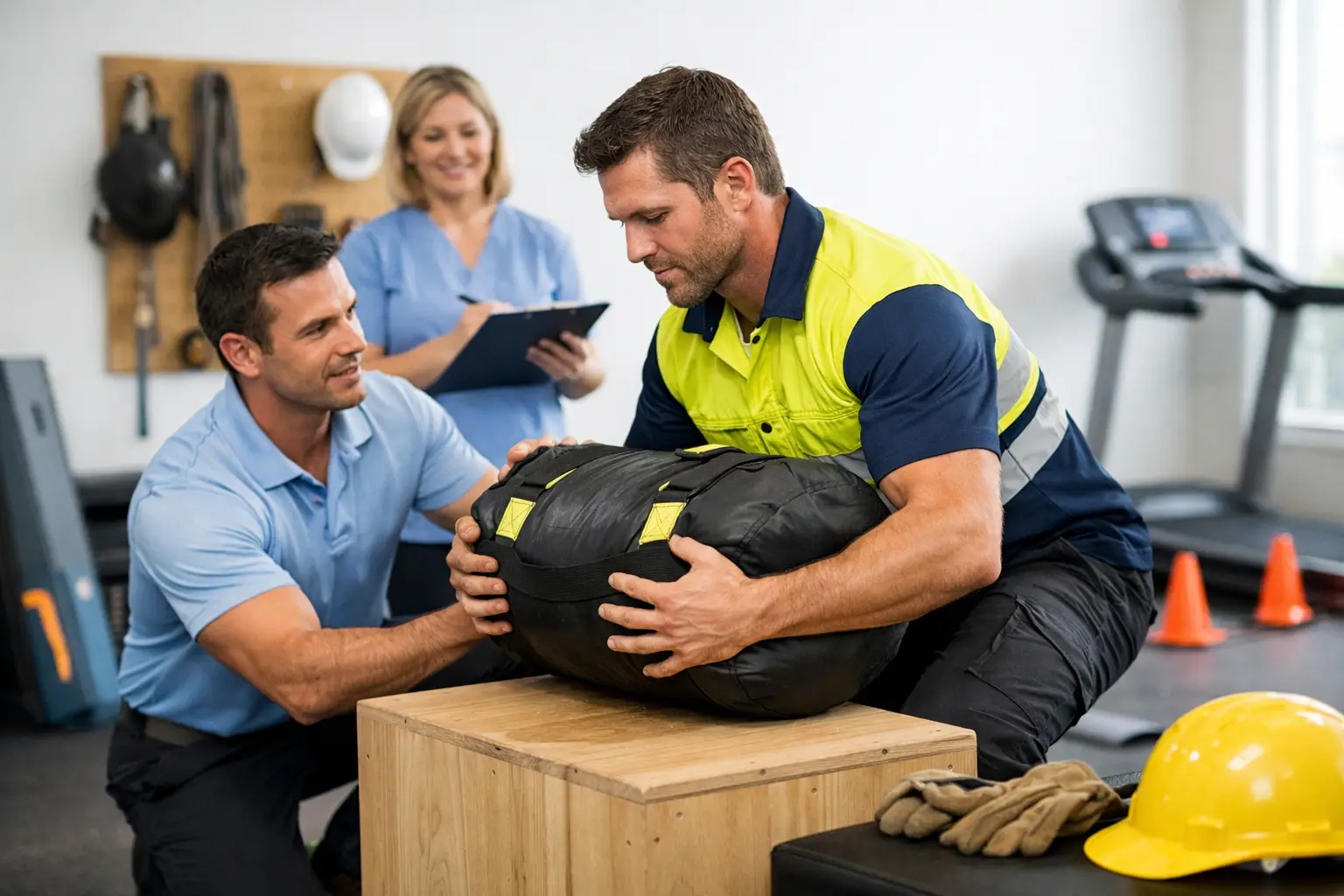
Missing work because of an injury creates more than a medical problem. It affects your routine, your income, your confidence, and sometimes your job security. A work hardening program physical therapy plan is designed for that exact gap between basic recovery and being truly ready to return to work. It focuses on rebuilding the strength, endurance, movement, and job-specific tolerance you need to perform safely and consistently.
For many people, pain improves before work capacity does. You may be able to walk, lift a light object, or get through a home exercise program, yet still struggle with standing for hours, carrying tools, climbing stairs repeatedly, pushing carts, or working at shoulder height. That difference matters. Returning too early can lead to reinjury, delayed healing, or ongoing limitations that make every shift harder than it should be.
What a work hardening program in physical or occupational therapy actually does
Work hardening is a structured, goal-driven rehabilitation program built around the physical demands of your job. It goes beyond symptom relief. The goal is to improve function in ways that match real work tasks, whether that means repeated lifting, sustained standing, squatting, reaching, pushing, pulling, or moving safely through a fast-paced environment.
In a standard physical therapy plan, treatment often centers on pain reduction, joint mobility, strength, and general movement patterns. Those are important building blocks. But if your job requires frequent material handling, awkward postures, ladder use, prolonged walking, or high repetition, general rehab may not be enough by itself.
A work hardening program adds intensity, task simulation, and measurable progression. Your therapist looks at where your current capacity stands, what your job requires, and what needs to improve before a safe return makes sense. That may include physical conditioning, body mechanics training, movement retraining, pacing strategies, and close monitoring of how you tolerate increasing demands over time.
Who may benefit from a work hardening program plan
This kind of program is often appropriate for injured workers who are medically stable but not yet ready for full-duty work. That includes people recovering from back injuries, shoulder injuries, knee problems, repetitive strain conditions, post-surgical cases, and other musculoskeletal issues that affect work function.
It can also help when recovery has plateaued in regular therapy, but the real challenge is still job performance. Someone may have enough strength for clinic exercises and still not be able to lift from floor to waist repeatedly for an eight-hour shift. Another person may have healed well after surgery but lack the stamina to tolerate a physically demanding workday.
That is why work hardening is often valuable for employers, case managers, and workers’ compensation teams as well. It gives a clearer picture of what the worker can do now, what still needs improvement, and how to support a safer transition back to work.
How the program is tailored to your job
The best work hardening plans are not generic. They are built around job demands, injury history, current limitations, and return-to-work goals. A warehouse employee, dental assistant, nurse, mechanic, delivery driver, teacher, and office worker may all need rehabilitation, but the physical demands are very different.
Your therapist starts by understanding both your condition and your job. That means looking at tasks such as lifting frequency, carrying distance, reaching height, sitting tolerance, bending, twisting, grip demands, walking surfaces, and schedule requirements. Some jobs depend on force and stamina. Others require fine motor control, sustained postures, or repeated movement at a specific pace.
Once those demands are clear, therapy can mirror them more closely. If your job involves repeated floor lifts, your program may include progressive lifting mechanics and lower-body strengthening under fatigue. If your work requires overhead use, the plan may focus on shoulder endurance, trunk stability, and repeated reach tolerance. If long periods of sitting or driving are the issue, treatment may center on posture variation, core control, hip mobility, and symptom management during sustained positions.
What happens during treatment
A work hardening session typically combines conditioning with functional task practice. You may work on cardiovascular endurance, lower- and upper-body strength, mobility, balance, and coordination, then apply those improvements to simulated work tasks.
The progression is intentional. Early sessions may focus on safe movement quality and baseline tolerance. As capacity improves, the program usually becomes more demanding in duration, resistance, repetition, and complexity. That matters because many work injuries are not caused by one heavy effort alone. They happen when a person is asked to repeat tasks while fatigued, rushed, or compensating for weakness.
Therapists also watch how you move, not just whether you complete a task. If you can lift a box but do it with poor mechanics, limited control, or increasing pain, that is a sign more work is needed. Good rehab is not about pushing through at any cost. It is about building durable function that holds up on the job.
Education is part of the process too. Patients often need guidance on pacing, symptom response, safe body mechanics, and how to manage the difference between expected post-exercise soreness and signs that an activity is too much. Those details can make the return to work smoother and less stressful.
How long does work hardening take?
It depends on the injury, the job, the stage of recovery, and how far your current abilities are from your work demands. Some people need a short, focused period of higher-level rehab. Others need a more gradual build because their work is physically demanding or they have been out for a long time.
The timeline is also influenced by whether restrictions are still in place, whether modified duty is available, and how consistently symptoms respond to increasing activity. Faster is not always better. If progression outpaces tissue healing or overall conditioning, the worker may return before they are truly prepared.
That said, the program should feel purposeful. You should understand what goals you are working toward and how those goals connect to your job. A good plan does not leave patients guessing.
Why objective progress matters
One of the strongest parts of work hardening is that progress can be measured in practical terms. Instead of only asking whether pain is better, the program looks at what you can safely do, for how long, and under what conditions.
That kind of documentation can be helpful across the board. Patients gain confidence when they can see concrete gains in lifting tolerance, endurance, walking time, or task repetition. Employers and case managers get clearer information about readiness and restrictions. Therapists can adjust treatment based on performance rather than assumptions.
It also helps clarify trade-offs. A person may be ready for part-time or modified duty before they are ready for full duty. Another may have the strength for occasional lifting but not the repeated volume required by their role. Honest, specific findings support better decisions than vague statements about feeling improved.
What makes a program effective
The most effective work hardening programs combine clinical skill with individual attention. They do not treat injured workers like a checklist. They consider pain levels, healing timelines, movement quality, confidence, job demands, and the practical realities of returning to a real workplace.
Hands-on clinical reasoning matters here. If someone is avoiding a movement because of fear, the solution may be different than if they are limited by weakness, stiffness, or nerve irritation. If symptoms rise only after cumulative activity, the therapist needs to train not just peak performance but sustained tolerance.
That is one reason many patients do better in an outpatient setting that values personalized care. At Saunders Therapy Centers, work-related rehabilitation is approached with that same focus on functional outcomes, individualized treatment, and direct communication that helps patients move from injured to capable. At Saunders, you will work with both physical therapists and occupational therapists who have specialized skill in return-to-work therapy.
When to ask about work hardening
If you have finished or nearly finished standard therapy but still question whether you can manage your job safely, it may be time to ask. The same is true if your pain is improving but your endurance is not, or if you are worried about going back and getting hurt again.
You do not need to wait until things become complicated. Early identification of work-specific gaps can prevent setbacks and reduce uncertainty. For some people, that means adding work hardening near the end of a regular therapy plan. For others, it becomes the main focus once basic healing and mobility are in place.
The right next step is not always rest, and it is not always a full return. Sometimes it is a more targeted bridge between recovery and real-world demands. A well-designed work hardening program can provide that bridge, giving you a safer path back to work and a clearer sense of what your body is ready to handle.